Ruth And Cobb Battled On The Greens

Ruth And Cobb Battled On The Greens

By Joe Guzzardi

When the U.S. Open field tees off at the Los Angeles Country Club, June 15, the golfers should give a hat tip to the man who made their $20 million purse possible – Babe Ruth, the sport’s pioneer. The “Big Bam” took up golf in 1914 when he was a rookie left-handed pitcher and played the Scottish Game all his life. Ruth recalled that one year he played 365 rounds, and wished for more. As Ruth said, “You never get anywhere in golf playing only four times a week.” His countless golf trophies housed in the Cooperstown Hall of Fame attest to Ruth’s command of the sport.

During the 1920s, excellent golfers like Bobby Jones and Walter Hagen played tournaments before sparse crowds. But when the Associated Press documented that Ruth, playing in Newton, at Massachusetts’ Woodland Golf Club, drove the ball more than 395 feet, the word got out, and interest in golf exploded. Until the 1900s, professionals refused to give golf lessons to left-handers. But because Ruth was the Babe, Scottish pro Alex Morrison, who also instructed Bing Crosby, Jack Dempsey and Charlie Chaplin, persuaded the New York Yankees’ home run king to abandon his baseball swing and adopt a more mature approach to his overall game. Ruth steadily improved, most noticeably his short game.

Ruth took up golf full-time after his baseball days ended, and he whittled his handicap down to 5. Ruth was a determined amateur golfer who loved to bet against his opponents. He won $100 a day wagers from fellow Hall of Famer Dizzy Dean and preeminent journalist Grantland Rice. When he retired, the Bambino was more available than ever to raise money for charity. Throughout his active playing days and after leaving baseball, Ruth always was ready to lend a hand to good causes.

In 1937, Ruth teamed up with Babe Didrikson Zaharias, a 1932 Summer Olympic three-metals winner, to fundraise for New York’s needy children. “Little Babe” and “the Big Babe,” as Zaharias called her childhood hero, set off pandemonium among the unheard-of 10,000-strong crown at Fresh Meadow Country Club in New York. The AP, again on the scene, reported that “the wildest and craziest crowd that ever stampeded through a sand trap” disrupted the event after Babe and Babe sewed up a win. Big Babe had a shirtsleeve torn off and was knocked to his feet. Little Babe bulldozed her way to safety.

Ruth played dozens of events, some at elite country clubs where food, drink and lodging were comped; others at municipal courses. At Ohio’s Acacia Country Club, while playing in The True Temper Open, Ruth drew Cleveland’s largest-ever crowd; at the Lakeside Country Club in California, Ruth played with celebrities Bing Crosby, Oliver Hardy and W.C. Fields. Then, on the 1939 inaugural Baseball Hall of Fame weekend and while at the Leatherstocking Golf Club in New York, Ty Cobb issued a golf challenge to Ruth, his bitter diamond rival: “I can beat you at the Scottish game any day of the week and twice on Sunday.” In 1941, after Cobb spent two years backpedaling, Ruth forced his hand: “If you want to get your brains knocked out, come right ahead.”

The two titans played opposite styles of baseball and golf. Ruth went for the long ball which Cobb, a small ball proponent, abhorred. In the never-ending debate about who the better player was, the “Georgia Peach” lorded over Ruth his higher inaugural HOF vote tally – 222-215. Now the famous duo would take to the links to decide who was better. Cobb’s 8 handicap versus Ruth’s 5 meant that an even-Steven match awaited enthusiastic fans. A best-of-three match play series was set for suburban areas around Boston, New York and Detroit, with the proceeds donated to children’s charities. The first two locations provided an edge for Ruth who played for the Red Sox and the Yankees, and the third venue favored Cobb, a Tigers great. The media hype rekindled the competitive juices between the adversaries. From Hollywood, Bette Davis wired the competitors: “May the best man win!” Match one went to Cobb, 3-2. After watching Cobb excel on the greens, Ruth called him “a putting fool.”

During a sweltering New York heatwave, Ruth won the second match on the 19th hole. In the tiebreaker, eternal bragging rights would be settled at Grosse Ile Country Club in Michigan. The golf was forgettable; Ruth shot 81, and Cobb 78. Cobb won the best of three 2-1 in what Ruth and he called “The Left-Handed Has-Beens Golf Championship.” Both winner and loser were gracious, and stayed close friends until Ruth’s 1948 death at age 53.

As Ruth described his looming demise from throat cancer, “the termites got me.” Later, when reminiscing about Ruth, Cobb said that he wished he could have been more like the Big Bam, friendly, outgoing and beloved. Cobb talked tearfully about how much he missed the man he called “a great, big kid.” Mellowed from his fiercely combative Tigers’ days, Cobb, a multimillionaire thanks to his Coca-Cola and General Motors investments, died in 1961 at age 74. The Georgia Peach took his MLB record .366 batting average with him to his grave.

Joe Guzzardi is a Society for American Baseball Research and Internet Baseball Writers Association member. Contact him at guzzjoe@yahoo.com.

Ruth And Cobb Battled On The Greens

Remembering Mark Vanderheld

Remembering Mark Vanderheld

By Joe Guzzardi

Mark Edward Vanderheid was born in Tonawanda, N.Y., on Feb. 11, 1949. Four months after his 20th birthday, and only six months after he arrived in South Vietnam in 1968, Vanderheid, a U.S. Marine Corps Lance Corporal, lay dead on the Quang Tri battle field; mortar shell fragments had torn his body open. Young Mark was one of 58,222 who died in the Vietnam War. Among the enemy, an estimated 1.1 million North Vietnamese and Viet Cong fighters were killed; 250,000 South Vietnamese soldiers died, and more than 2 million innocent civilians were killed.

The futile war in Vietnam began in 1959 when the first U.S. soldiers were killed during a guerrilla raid on their quarters near Saigon; the war ended ignominiously in 1975. U.S. forces never had a chance. President Lyndon Johnson and Secretary of Defense Robert McNamara, the powers that escalated the war, had no exit strategy, and knew that Americans back home would be unwilling to make a sustainable commitment to victory. Such a pledge would mean higher taxes to support Johnson’s guns and butter economy, thousands more lost lives and more domestic turmoil. In 1997, during a meeting with McNamara, Vietnamese General Vo Nguyen Giap told his foe that the U.S. could never have won. The Vietnamese, Giap said, were willing to fight for 100 years.

At different times and to different degrees, Presidents Kennedy, Johnson and Nixon – the war’s architects – realized that Vietnam was a morass, a disaster in the making, and defeat, inevitable. McNamara: “We were wrong, terribly wrong.” Their too-late awakening was cold comfort to Lillian and Edward Vanderheid, Mark’s parents, as well as to the other families whose loved ones, while defending a misguided, and ultimately failed cause, died too young.

Mark’s body was returned to Tonawanda in July, and he was buried with military services at Elmlawn Cemetery. On Dec. 19, 1968, the Tonawanda News published a letter from the Vanderheid family in which they shared memories of their hero son, and expressed gratitude for the two memorials that had recently been dedicated to Mark, one an award given in his name to the most spirited Tonawanda High School varsity football player. The other memorial, Lillian and Edward wrote, is the Payne Avenue Christian Church’s “beautiful stained-glass window.” The letter continued: “Words just can’t express the deep feeling within us as we sat in church listening to the memorial dedication service the young friends of Mark’s had to dedicate the stained-glass window that has been put in our church in memory of him. May God Bless you all.”

Grieving Lillian and Edward remembered how Mark loved to play sports and teach other young boys how to play. He coached Little League and also umpired games. Lillian thought back to one day when Mark was home on leave and said, “Mom, someone has to help those people over there. Those kids have never known anything but war. If I can do even a small part to help them to someday just be kids and enjoy a childhood like I did, to be able to throw baseballs and footballs instead of hand grenades, I’ll have done my part.” Lance Corporal Vanderheid did more than his part, and deserved to live a full, rewarding life. The Kennedy, Johnson, Nixon Vietnam war-obsessed White Houses stole from Mark, and from other thousands, that basic privilege.

Mark’s name is on the Vietnam Veteran’s Memorial in Washington, D.C., panel W54, line 8. His biography appeared in Gary Bedingfield’s “Baseball’s Greatest Sacrifice,” dedicated to the 500 players who died in service to America.

Joe Guzzardi is a Society for American Baseball Research and Internet Baseball Writers Association member. Contact him at guzzjoe@yahoo.com.

Remembering Mark Vanderheld

Christina Gehrig, the Iron Horse’s Iron-Fisted Mom

Christina Gehrig, the Iron Horse’s Iron-Fisted Mom

By Joe Guzzardi

Lou Gehrig had two women in his life, his mother Christina and his wife Eleanor. Had the two been able to get along, the personal life of the legendary New York Yankees ballplayer and Hall of Famer would have been less stressful.

During Gehrig’s youth, Christina, a first-generation German immigrant, was the family’s backbone. Father Heinrich was mostly unemployed, drank and was frequently ill. Lou was the only one of the Gehrig babies to reach adulthood. Three others died in their infancy. Understandably, Christina became overprotective of Lou and urged him to abandon baseball, which he picked up as a teen playing in neighborhood games. She wanted him to focus on his school books.

When Gehrig enrolled in Manhattan’s Commerce High School, he starred in football and baseball. After Gehrig’s Commerce team beat Chicago’s Lane Tech High in Cubs Park, later Wrigley Field, the 10,000 in attendance knew they had seen a superstar in the making. In an account of Gehrig’s game-winning grand slam, the Chicago Tribune wrote that “his blow would have made any big leaguer proud….”

The Gehrig family was poor. While in high school, Christina worked as a Columbia University housekeeper at Sigma Nu Theta. Lou often went to the fraternity house to help his mother serve dinner and wash dishes. Gehrig also worked part-time jobs in butcher shops and grocery stores to help supplement the household income. A New York Giants scout arranged a 1921 Polo Grounds tryout for Gehrig, but no-nonsense manager John McGraw screamed at his coaches to get him off the field: “I’ve got enough lousy players without another one showing up.” For the balance of his managerial career, McGraw rued his hasty decision.

Christina Gehrig, the Iron Horse’s Iron-Fisted Mom
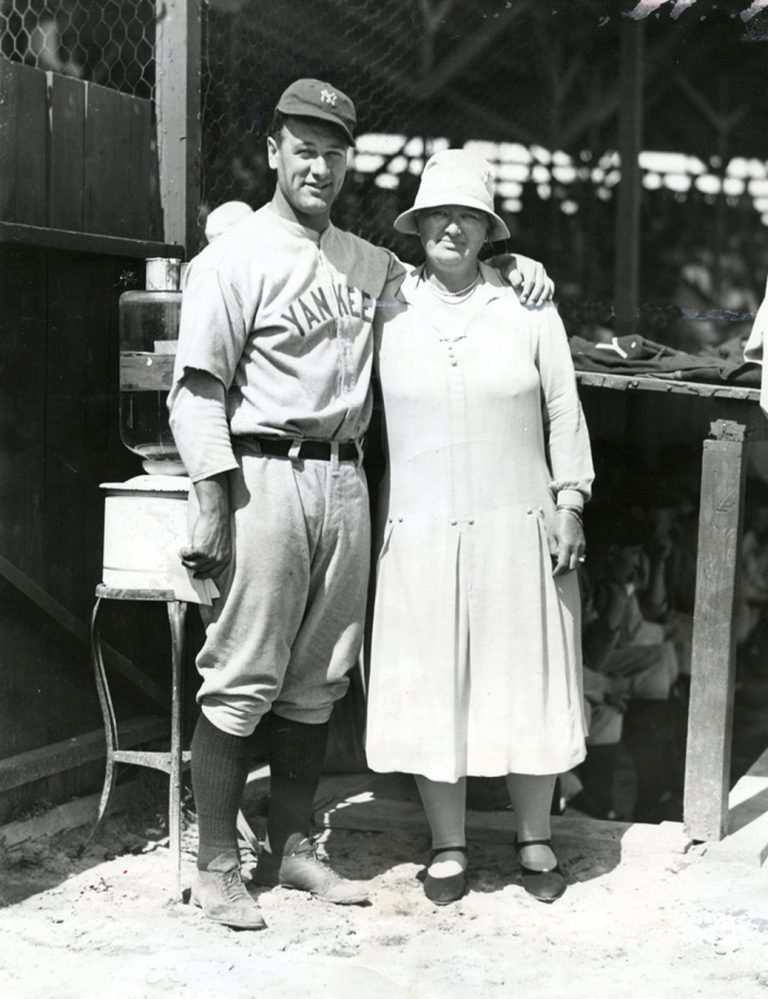
Lou and Christina

By 1925, Gehrig, age 22, was an established Yankees starter who began to challenge teammate Babe Ruth for homerun titles. The two, despite contrasting personalities – the shy, retiring Gehrig and the bombastic Ruth – became friends, fishing buddies and barnstorming partners, the “Bustin’ Babes vs. the Larrupin’ Lous. Christina, who by this time realized that professional baseball players could earn good paychecks, loved Ruth. The Bambino gifted Christina a puppy which she named Judge, a nickname for Ruth. The extra money Ruth generated was nice too. Lou made $2,000 more on the barnstorming tour than he did during the season.

Ironically, Ruth was at the center of a lifelong feud between Lou and his mother. Christina took a dim view of Lou’s girlfriends, seeing them as threats eager to win away her beloved son. When Chicago socialite Eleanor Grace Twitchell caught Lou’s eye, Christina strongly disapproved. In her autobiography, “My Luke and I,” Eleanor described herself as “young and rather innocent, but I smoked, played poker and drank bathtub gin….” But smoking and drinking weren’t the vices that most bothered Christina.

Mother Gehrig had heard through the grapevine that on a years-ago trip to Chicago, Ruth befriended Eleanor. Christina, and the entire baseball world, knew that Ruth didn’t maintain platonic relationships with women. When Lou and Eleanor married in 1933, friends had to persuade Christina to attend.

As Lou’s career flourished, the women cheered Lou on, albeit from separate vantage points. Christina and Eleanor watched with pride as Lou closed in on the most-consecutive-games-played record, then 2,130. But the rift between Christina and Eleanor never healed. Lou’s physical condition deteriorated – “like a great clock winding down,” wrote Eleanor. A butler, a housekeeper and his mother-in-law who moved into the couple’s two-story home in Riverdale nursed Gehrig, but not Christina.

After Lou passed, tension between the in-laws deepened. The parties disputed how Lou’s estate should have been divided. Heinrich and Christina believed that Eleanor was withholding monthly payments from a $20,000 life insurance policy payable to Lou’s parents. An out-of-court settlement was reached.

Christina and Heinrich faded from the news, and died quietly. Eleanor, however, remained prominent, at least publicly. Married to Lou for only eight years, widowed for 43, Eleanor approved the final draft of “The Pride of the Yankees,” donated Lou’s baseball treasures to the Hall of Fame, left $100,000 to Columbia Presbyterian Hospital, and another $100,000 to the Rip Van Winkle Fund for ALS research.

Privately, a lonely, friendless and childless Eleanor withdrew, drank excessively and, once, passed out, caught her bed on fire from smoking. At Eleanor’s 1984 funeral, only two attended, her attorney George Pollack and his wife. And so ended the sad Gehrig family saga; Lou gone too soon, and his family unhappily bickering all the way to their graves.

Joe Guzzardi is a Society for American Baseball Research and Internet Baseball Writers Association member. Contact him at guzzjoe@yahoo.com.
Child Labor Back In Vogue

Child Labor Back In Vogue

By Joe Guzzardi

Even though the nation is divided about immigration and its consequences, on one point, unanimity must be reached. Immigration, whether legal or illegal, cannot be a vehicle for child labor. And yet, the Department of Labor has uncovered several incidents that involve under-age migrants working in slave labor-like conditions.

A DOL Tweet: “Packers Sanitation Services Inc. has paid $1.5 M after @WHD_DOL investigators found the company employed at least 102 children-aged 13-17 – in hazardous occupations and had them working overnight shifts in 13 meat processing facilities in eight states.” Furthermore, DOL accused PSSI of employing “oppressive child labor in perilous conditions.”

In a series of stories, NBC News provided the horrific details. PSSI, a company contracted to work at slaughterhouses and meatpacking facilities throughout the county, allegedly employed at least 31 kids – one as young as 13 – to work overnight cleaning shifts at three facilities in Nebraska and Minnesota, a Fair Labor Standards Act violation. Additional evidence indicated that the company may also have employed more under-age children in similar perilous conditions at 400 other sites nationwide. Identity theft is rampant and a major facilitator in underage migrant employment.

PSSI is a huge company that employs about 17,000 and has contracts with hundreds of meatpacking facilities. Toiling at PSSI wasn’t an after-school job at the soda parlor. During the graveyard shift and across three slaughter houses, when they should have been home in bed, minors literally slaved away, mopping up bloody floors.

Interviews with the minors, in their native Spanish language, revealed that several children began their slaughterhouse shifts at 11 p.m. and worked until dawn, some for six or seven days a week, and often for periods of up to 15 months. At least three victims suffered chemical burns.

The NBC News story skirted the central factor that abets minor children’s criminal employment – President Biden and Department of Homeland Security Secretary Alejandro Mayorkas’ open border. Don’t be misled. The media’s deceptive language about “unaccompanied minors” (UACs) is intended to deflect the truth – UACs are more accurately described as the victims of child smuggling rings and are tied into the Biden administration’s open borders policy. As the minors mature into adulthood, they become embedded in the permanent labor force. To most of them, any job is a good job. They need incomes to send remittances back home and to pay off their smuggling fees.

U.S. Customs and Border Protection statistics show that after President Biden took office in January 2021, he acted immediately to eliminate effective policies, including categorically exempting UACs from Title 42. UAC encounters skyrocketed. Between FY 2020 and FY 2021, total UAC encounters at the Southwest border increased a staggering 342 percent, from 33,239 in FY 2020 to 146,913 in FY 2021. Those encounters increased to 152,057 in FY 2022 and are on pace to be at a similar level in FY 2023.

At a recent Senate hearing, Secretary Mayorkas couldn’t explain the child exploitation surge under his watch, a fact that The New York Times described as “ignored or missed.” Multiple veteran government staffers and outside contractors told the Health and Human Services Department, including in reports which reached Secretary Xavier Becerra, that children could be at risk. Critics had previously brought to Mayorkas’ attention that the DHS Office of Refugee Resettlement routinely releases minors into the custody of unvetted families, many of whom are illegally present, and likely also illegally employed. The Labor Department also issued news releases that noted an increase in child labor. Senior White House aides were shown proof of exploitation, like migrants working with heavy industrial equipment and caustic chemicals. The net result of multiple efforts to shine light on booming child exploitation: nothing.

Multiple felonies are committed on every step of the journey from the border to the slaughterhouse. Corrupt government and private sector employers hold the upper hand. Fines are meaningless. Hard jail time might make a difference. But if Congress can’t pass mandatory E-Verify, it’s unlikely to put its weight behind throwing the donor class behind bars.

Joe Guzzardi is a Project for Immigration Reform analyst. Contact him at jguzzardi@pfirdc.org.

Child Labor Back In Vogue
Child Labor Back In Vogue Child Labor Back In Vogue

Colorado Chooses Sprawl For Earth Day

Colorado Chooses Sprawl For Earth Day

By Joe Guzzardi

From coast-to-coast, concerned citizens have formed “Save our Neighborhood” organizations to protect their communities against relentless, all-consuming development. Politicians at the federal, state and local level demand more growth, residents’ wishes be damned.

Consider Colorado. Because of the Centennial State’s environmental bounty, thousands of disgruntled Americans left home to make Colorado their new residence. But Colorado’s appeal is on the wane. Gov. Jared Polis’ bill, SB 23–213, also known as the “More Housing Now” proposal, will keep Colorado sprawling, especially in already overcrowded metropolises like Denver, Colorado Springs, Fort Collins and Boulder. More Housing Now designated these, and other major cities, as “Tier One,” targeted areas where single-family-only zoning would end, allowing permitting of duplexes, triplexes and add-on housing units. The land-use bill would block established limits on how many unrelated people can live in the same home.

The Polis administration’s dream plan would, over the objections of residents and elected officials, allow more dense housing across Colorado’s increasingly expensive metropolitan and resort areas. Traditionally, local governments in Colorado have had the authority to make their own growth decisions; under SB 23–213, that authority would shift to the governor’s office.

Polis’ power grab will put the governor and state legislature on a collision course with cities and counties. Colorado Springs Mayor John Suthers, who attended Polis’ State of the State announcement, declared the bill “a pretty scary prospect” for local officials who would lose local land use control, as it’s transferred to the state capitol.

The Colorado Municipal League is also critical. In its statement, the League said that the bill would alter more than 100 years of municipal authority over Colorado’s land use and zoning: “It’s a vote of no confidence in local government and in citizens in having a say in how they would like their own neighborhoods and communities to develop.” Although the few Republicans in the legislature will push back, the stark reality is they’re the minority party and have little influence over which measures pass.

Colorado Chooses Sprawl For Earth Day

In Colorado, and in other states, building can never catch up to population growth. Developers attempting to match ever-higher population levels to housing starts are on fools’ missions. Colorado has experienced a population boom that has recast the state’s image as a final destination to get away from it all. Since 2010, Colorado’s population grew 15.1 percent to 5.8 million, more than twice the 7.3 percent national average. The U.S. Department of Agriculture calculates that Colorado, over the last four decades, has turned more than 1,250 square miles of open space, natural habitat and agricultural land into housing, shopping malls and streets.

Demographers project that the state’s 5.8 million population will, by 2050, increase by another 1.8 million. Colorado Springs, Denver and Fort Collins, all Tier One cities, will become a single mega-city. When polled about growth, Coloradans are opposedThey want a future that has fewer arriving people. Nearly three of every five voters, 59 percent, prefer either a complete stop or a decline in the state’s population growth. Population stability is a key issue that few elected, corporate or civic leaders will discuss. To help Colorado reach sustainable population, the state needs manageable immigration, the federal policy that, along with births to immigrants, drives more than 75 percent of all growth.

Coloradans should brace for more housing. Polis is pro-growth, but opposed to immigration limits. During his five terms as a U.S. Representative where his districtincluded the Tier One cities of Boulder and Fort Collins, Polis consistently voted in favor of expanded immigration and less enforcement at the border, as well as in the interior.

Under Polis, Earth Day celebrations will be de rigueur, but meaningless charades. Other Coloradans, now deceased, like former Gov. Richard Lamm and Professor Al Bartlett, who spoke about protecting the Centennial State’s environment, would be disappointed and dismayed about what lays ahead.

As Professor Bartlett said: “The first law of sustainability is that you cannot sustain population growth; you cannot sustain growth in the rates of consumption of resources. That’s just arithmetic — it is not debatable.”

Joe Guzzardi writes about immigration issues and impacts.

Colorado Chooses Sprawl For Earth Day

Pop Growth Outpaces Housing Starts

Pop Growth Outpaces Housing Starts

By Joe Guzzardi

Pop Growth Outpaces Housing Starts

The nation’s housing shortage, 6.5 million homes, is an out-of-control crisis, according to CNN’s dire warning last month. Between 2012 and 2022, 15.6 million households were formed. During the same period, 13 million housing units (9 million single-family homes and 4 million multi-family homes) were started. Of the 13 million, 11.9 million were completed (8.5 million single-family homes and 3.4 million multi-family homes).

In 2021’s second half and the first part of 2022, the fast-paced building spurt continued. Then, with the Federal Reserve determined that slowing inflation was essential, interest rates including those on mortgages rose, and housing demand cooled. Builders backed away from single-family housing starts. The solution to the shortage, CNN predicted, would be to triple the single-family home housing starts which would, within three or four years, close the existing 6.5 million shortage, and keep up with new demand.

The CNN story mentioned, but did not elaborate on, the shortage’s cause: in 2022, the U.S. saw the last decade’s highest annual household formation level with 2.06 million new households. Population growth, long ignored by Congress and the establishment media as toxic and unmentionable, drives the need for more development. The equation between ever-more people and the need to build homes for them is obvious, but unmentionable. Accelerating growth remains taboo because the subject will eventually come around to immigration, an even more uncomfortable topic.

The math that the Census Bureau and other federal agencies provide is inarguable. Every year, more than 1 million permanent residents enter the U.S. Another 1 million arrive on temporary employment visas. Whether they return to their home countries or not, they need housing during their visa’s term. Since Biden’s inauguration, his administration’s open border policy has welcomed about 5 million asylum seekers, with millions more to come before the president’s 2024 re-election bid.

Add more than 2 million gotaways — the 1.2 million to date that Customs and Border Protection knows about and the roughly million certain to elude border agents in the next 18 months. During the Biden administration’s four years, between 10 and 15 million legal permanent residents, guest workers, asylum seekers and gotaways will need housing. The Census Bureau predicts that by 2060 the nation’s immigrant population will rise from its current 14.3 percent to 17.1 percent of the total U.S. population.

The powerful pro-growth lobby maintains a $60 million Capitol Hill presence, and Congress’ informal motto is “the more, the better,” especially if it makes donors’ wishes come true. The list of negatives that over-development worsens is long. Among them are biodiversity loss, carbon emission increases and overcrowding. At the top of the list, however, are water shortages, a problem so acute that the Biden administration has proposed cutting the Colorado River’s water allotments delivered to California, Arizona and Nevada by as much as one-quarter. The Colorado River provides drinking water to 40 million Americans and irrigates 5.5 million agricultural acres.

With water running low and development an increasing environmental scourge, a responsible federal government would comply with the requirement to weigh the environmental effect on any new policies it enacts; opening the Southwest and Northern Borders would be such a policy. The National Environmental Policy Act and the Endangered Species Act require an environmental impact study. But like U.S. immigration laws, the Biden administration ignores the federally mandated obligation to conduct environmental impact studies, perhaps because it knows that the results would be catastrophic to developers and to Biden’s commitment to mass immigration.

Immigration and births to immigrants are the biggest population growth drivers in the U.S. As long as the status quo continues, housing demand will be impossible to fully satisfy. Good luck to builders tackling that challenge, especially in the increasingly dry Southwest, and good luck to the established neighborhoods that will have to cope with the quality-of-life-altering sprawl that overdevelopment creates.

Pop Growth Outpaces Housing Starts

Joe Guzzardi writes about immigration issues and impacts.

Pop Growth Outpaces Housing Starts

Giant Cruise Ships Bad For Environment

Giant Cruise Ships Bad For Environment

By Joe Guzzardi

Giant Cruise Ships Bad For Environment

The cruise ship industry puts out beguiling advertisements intended to attract more customers on board. Showing couples in summer wear, sipping cocktails and looking out over the ocean to watch the setting sun as they sail off to a distant, romantic destination, ads appear everywhere, from television, social media and movie previews to subway cars.

A closer look at the cruise ship business and its harmful effects on the ecosystem paint a far grimmer picture than advertisements convey. Hakai Magazine, an online publication that focuses on science and society in coastal regions, created the route of the Oceanic Topaz, a fictional but representative cruise ship, on a seven-day journey from Seattle to Alaska. The weeklong trip stopped at various ports like Juneau, Ketchikan and Victoria, before returning to Seattle.

This year, an estimated 700,000 passengers will depart Seattle on hundreds of different cruises. Travelers’ voyages are on increasingly massive ships that house, feed and process the waste of upward of 4,000 passengers. From 2015 until today, the average weight of a major line’s new cruise ship was 164,000 gross tons — more than twice the size of a ship built during the 1990s. The Symphony of the Seas weighs a staggering 228,081 gross tons.

Touted as inexpensive, all-inclusive vacations, Pacific Northwest cruises deliver thousands of people to the glaciers, fjords and small towns of southeast Alaska. Cruises are an integral part of the Pacific Northwest’s tourism economy, but they bring with them significant environmental degradation and deleterious human consequences. Carbon emissions, wastewater discharges, engine and propeller noise, mountains of trash and an unmanageable tourist influx have had a damaging cumulative impact on the ecosystems of tiny communities. As they move from stop-to-stop, the massive vessels disrupt fish, whales and birds; while docked, residents.

This tourism season, 13 ships will make 291 trips between Seattle and Alaska; the imaginary Oceanic Topaz will begin its journey in Seattle which derives significant economic benefits from cruise passengers. In 2022, cruise tourists spend around $900 million in the greater Seattle area, income that supports about 5,500 jobs. That’s the good news. On the other hand, as an Alaska-bound ship sets sail, its 3,600 passengers go about their daily business of flushing toilets, showering and brushing teeth. Each passenger will produce a daily average of 7 gallons of sewage — also known as black water — and about 66 gallons of wastewater from showers, pools, laundry and other non-sewage runoff known as gray water. For a ship carrying 3,600 people, that amounts to about 400 eight-person hot tubs worth of sewage and over 3,000 hot tubs worth of gray water each day.

A grand ship voyage with dramatic views and promised nonstop fun on board is hard for tourists to resist. But add together the carbon emissions, wastewater pollution, noise impacts, trash, thousands of tourists and the impact on wildlife, and the negative effect of cruising is overwhelming.

The argument for economic gains for small communities is understandable and persuasive. But as the Oceanic Topaz example shows, the regions that host these mammoth floating hotels also have a lot to lose. In 2019, in Victoria, where cruise ships have the option to offload accumulated garbage rather than return it to their home port of Seattle, the equivalent of 100 fully loaded garbage trucks were dumped in the region’s Hartland Landfill.

Pre-COVID, the cruise industry’s aggregate revenue hit $27 billion. The U.S., with its long coastlines and easy access to Caribbean ports, leads the world in cruise revenue. By 2026, cruise revenue is expected to reach $35 billion.

Cruise lines have a powerful presence in Washington, D.C. Unlike U.S. airlines and hotels, cruise lines did not benefit from generous government subsidies since they are not registered in the U.S., and therefore American laws do not entirely bind them. Consequently, lobbying by cruise lines spiked from the average $3.5 million between 2009 and 2019 to $4.4 million in 2020 and $5.3 million in 2021. The objective: to get those floating hotels back on the water after the sharp COVID-19-related decline.

An all-out ban on cruise ships is unrealistic, but daily limits at ports-of-call make sense. Based in part on a 2022 commissioned study that the Juneau Assembly requested and in which 74 percent of residents supported limits, the final approval urged a five-ship limit. But such an obvious idea to at least reduce the adverse outcome for residents and the ecosystem has little chance against Big Money interests.

Giant Cruise Ships Bad For Environment

Joe Guzzardi writes about immigration issues and impacts. Find his immigration pieces at Immigration News on Substack.

Giant Cruise Ships Bad For Environment

Mickey Mantle’s Regrets

Mickey Mantle’s Regrets

By Joe Guzzardi

In 1994, a year before his death from alcohol-induced cirrhosis, hepatitis C and inoperable liver cancer, Mickey Mantle gave a remorseful interview to Sports Illustrated. The New York Yankees superstar center fielder and first-ballot Hall of Fame inductee recounted his life as an alcoholic with brutal candor. Mantle admitted that because of alcohol abuse, he ended up “killing himself.”

Except to other alcoholics, Mantle’s confession about how drinking kept him from living a more fulfilling life and ruptured his relationships with friends and family doesn’t square with baseball diamond fame. Mantle began some of his mornings with what he called the “breakfast of champions,” a big glass filled with a shot or more of brandy, some Kahlúa and cream. Yankees’ second baseman Billy Martin, a regular drinking partner, and Mantle would stop at Mickey’s Central Park South restaurant where the bartender blended the ingredients and served them up. As Mickey remembered, the frozen drinks “tasted real good.”

Mantle’s “breakfast of champions” was the first of many drinks he threw back each day. Inevitably, Mickey’s heavy drinking led to long blackout periods. By his own admission, Mantle would forget what day it was, what city he was in and about his commitments to appear at baseball card signing shows, although he eventually showed up. The best man at Martin’s 1988 wedding, Mantle “hardly remember(ed) being there.” One year later, Mantle served as a pallbearer at Martin’s funeral. Billy had been killed in a single vehicle automobile accident on Christmas Day. Although there is some dispute about whether Martin or his friend Bill Reedy drove, no one questions that the pair had been drinking heavily in the hours before the fatal crash.

Mickey Mantle’s Regrets

After Mantle retired, his drinking became, in his words, “really bad.” He went through a deep depression. Teammates Billy, Whitey Ford, Hank Bauer and Moose Skowron were part of his past life, and leaving those guys “left a hole in me.” Mantle tried to fill up his baseball emptiness with nonstop alcohol intake.

The older Mantle got, the more he drank. Family and friends begged Mantle to get help. But Mantle stubbornly refused. Like too many alcoholics, Mantle foolishly convinced himself that he could stop whenever he wanted. But at a charity golf outing for the Harbor Club Children’s Christmas Fund near Atlanta, Mantle hit bottom. He drank Bloody Marys in the morning, and then downed two bottles of wine in the afternoon. At the card show that evening, Mantle embarrassed himself with his obnoxious, drunken behavior. In his alcohol-fueled stupors, Mantle often berated autograph seekers, a shock to his fans who cherished his image as a homey, blond-hair, crewcut Oklahoma kid.

Atlanta was an overdue awakening for Mantle. Finally seeking guidance, Mantle approached his son Danny who had been treated at the Betty Ford Center. Three of Mantle’s four sons and his wife Merlyn were also alcoholics. While Mantle deliberated about checking into the Betty Ford Center, his doctor gave him his MRI results: Mickey needed a liver transplant.

Once at Betty Ford, Mantle confronted his uncomfortable truth. Mantle admitted that, as he told Sports Illustrated, “he really screwed up,” was a lousy family man, and preferred running around with his baseball buddies. Envisioning his life as a sober, responsible Mantle, Mickey had big plans, but did not live long enough to realize them to the fullest. His goal was to stay sober, be strong and make amends. At his final press conference, Mantle said to an audience aghast at his wasted-away body: “This is a role model: Don’t be like me.”

Today, Mantle is remembered mostly for his brilliant baseball achievements: 20 All-Star games, three AL MVP awards including one in his 1956 Triple Crown season, seven World Series championship rings, four AL Home Run crowns, and a first ballot Hall of Fame inductee.

But for the millions of Americans suffering from alcoholism, Mantle’s ability to overcome – although too late to save his life – is a bigger triumph than any of his baseball feats. For more information, go to the National Alcohol Awareness Month website here.

Joe Guzzardi is a Society for American Baseball Research and Internet Baseball Writers Association member. You can also read his content here. Contact him at guzzjoe@yahoo.com.

Mickey Mantle’s Regrets Mickey Mantle’s Regrets

China Perpetrating Greatest Transfer of Wealth in History

China Perpetrating Greatest Transfer of Wealth in History

By Joe Guzzardi

Customs and Border Protection agents have identified individuals from more than 150 nations attempting, mostly successfully, to enter the United States. Among those aliens, the Chinese are arriving in increasingly large numbers.

The journey for these Chinese is thousands of miles long, costly and dangerous — one that few would willingly embark upon since their futures, once in the U.S., would be uncertain. The Chinese migrants speak little English and have limited work skills. Nevertheless, one Chinese migrant, Zhang Kiayu, began his journey north in Ecuador, then traveled through Colombia, passed through the treacherous Darien Gap where smugglers then coordinated his travel on to Panama before reaching the Mexico/Texas border. Speculation is on the rise that the migrants may be Chinese Communist Party agents. A CCP affiliation would explain who funded the $35,000 Kiayu paid traffickers.

Texas Department of Public Safety Lt. Chris Olivarez said that the spike in Chinese migrants is unusual and “very alarming.” Olivarez blamed the cartels who are, he said, running a “very lucrative business.” During February 2023, there were 1,368 encounters of Chinese migrants versus 55 during February 2022. Since October, just five months into the current fiscal year, the total has grown to 4,366.

Chinese immigration to the U.S. has a long and often turbulent history. The 1882 Chinese Exclusion Act and restrictions that the Chinese government imposed after World War II and the Chinese Communist Revolution limited migration. But after the Immigration and Naturalization Act of 1965 removed the barriers for non-European immigrants, and after China relaxed it emigration restrictions, the number of Chinese immigrants residing in the U.S. nearly doubled from 370,000 in 1980 to 677,000 in 1990. The number doubled again by 2000 to more than 1.8 million before reaching 2.4 million in 2021. The Chinese population has continued to grow. Chinese Americans are the largest Asian origin group in the U.S.and represent the third largest origin group after Mexican and Indian migrants.

There’s an important distinction between then and now, however. The Chinese surging the border are illegal aliens as opposed to earlier waves that, for the most part, arrived in the U.S. through a legal port of entry and held a valid visa. Kiayu and the others released at the Southwest border were given notices to appear for an immigration hearing. Even if their intention is to show up, and fewer than half do, appointments are often backlogged for up to seven years. During the waiting period, the whereabouts and the intentions of the unvetted migrants, Chinese and otherwise, will remain unknown. Evaluating the arriving Chinese, some wonder if given the CCP’s quest for world domination, their government might be motivated to take advantage of the Biden administration’s open borders to smuggle agents into the U.S.

The Biden administration may play down or even dismiss the national security threat that China represents, but FBI Director Christopher Wray has a different perspective. Wray points to what the FBI calls China’s “Talent Plans” that allow its nationals with existing jobs in the U.S. “to participate in such plans part-time so they can maintain their access to intellectual property, trade secrets, pre-publication data and methods, and U.S. funding for their research.” These plans, maintains the FBI, represent a risk to universities, laboratories and U.S. businesses. Wray told a Hudson Institute audience that the FBI opens a new case related to China every 10 hours and that 50 percent of the roughly 5,000 active FBI counterintelligence cases are China-related.

China’s foreign minister Qin Gang warned of pending “conflict and confrontation” with the U.S. In turn, the Department of State cautioned against U.S. citizens traveling to China because of “arbitrary enforcement of local laws” and the risk of wrongful detention.

FBI alerts about Chinese interference in U.S. affairs are more than hypothetical. In 2018, the U.S. Trade Representative estimated that Chinese theft of American IP costs U.S. firms between $225 billion and $600 billion every year. In 2014, China stole the files of more than 22 million Americans, including the security-clearance files of everyone in the intelligence establishment. General Keith Alexander, a former National Security Agency director, has called China’s technology theft “the greatest transfer of wealth in human history.”

With red flags flying, and with the stakes at American universities, laboratories and businesses high, Biden’s indifference to the Chinese entering illegally, and virtually at will, proves his callous disregard for the nation he’s sworn to defend and the citizens who trusted him.

Joe Guzzardi writes about immigration issues and impacts. Sign up here for free to receive immigration columns in your inbox.

China Perpetrating Greatest Transfer of Wealth in History

Opening Day 1923 In The House That Ruth Built

Opening Day 1923 In The House That Ruth Built

By Joe Guzzardi

Opening Day, 1923, a century ago, dawned cloudy and cold. Babe Ruth woke up in his plush Upper West Side Ansonia Hotel apartment and prepared to play the first-ever game in the brand-new edifice that would become known as the “House that Ruth Built.” Always a snappy dresser, Ruth donned his perfectly tailored suit, then around noon, hopped into his Pierce-Arrow automobile to drive to the Bronx. Had the weather been warmer, Ruth would have selected his sporty Stutz Bearcat.

A notoriously reckless motorist, Ruth had been involved in numerous minor collisions and rarely held a valid driver’s license. To avoid incidents, the Yankees’ owner, Col. Jacob Ruppert, sent police to escort the “Big Bam” safely to the stadium. Along the way, Ruth stopped to sign a few autographs and invited some kids to join him as he roared along.

The largest baseball crowd ever – 74,000, with 25,000 turned away – witnessed a pre-game ceremony befitting the stadium’s grandeur. While New York Gov. Al Smith looked on, John Phillip Sousa led the Seventh Regiment Army Band in full military dress onto the field.

Opening Day 1923 In The House That Ruth Built
Babe Ruth and John McGraw

In 1923, Ruth was on a redemption mission, and the new Yankee Stadium, the biggest and most lavish ever built, was the perfect place to carry out his undertaking. Ruth considered his 1922 season a failure. His performance at the plate, for him a paltry .315 batting average with 35 home runs and 99 RBIs, a sharp drop off from 1921, embarrassed Ruth. Moreover, during the season, Ruth was suspended five times. Worst of all, Ruth’s final 1922 baseball appearance was against the New York Giants in the World Series in which Ruth hit a pathetic .188. Giants’ manager John McGraw called every pitch from the bench. Some were slow curves that Ruth swung on, twisting himself into a corkscrew while missing by a mile. During the off-season, McGraw, a scientific baseball genius, chided Ruth whose style of play – the long ball – he disdained. McGraw called Ruth “the Big Baboon” and incorrectly predicted that the home run fad would soon die out. The media and fans got on Ruth too. The New York Sun labeled Ruth “an exploded phenomenon,” and for the first time, Ruth heard boos.

A humbled Ruth vowed to make amends, on and off the field. Over the winter months, Ruth said that liquor never touched his lips. And now the day had come, April 18, against the last place Boston Red Sox, for Ruth to regain respect and admiration from teammates and his millions of fans. Before the game, Ruth said in the locker room that he would “give a year off his life” to hit a homer in the season opener.

Red Sox starter Howard Ehmke, taking a page out of McGraw’s book, tossed junk balls to Ruth, and in the first inning the Bambino flied out. The third inning, however, was a different story. With two Yankees on base, Ruth deposited a titanic homer ten rows back in the right-field bleachers. Rush’s blast made the score 4-0, a lead the Yankees never relinquished.

As the season unfolded, Ruth and the Yankees dominated. The Yankees won the American League pennant by 16 games over the Cleveland Indians. Ruth hit .393, 41 homers, and unanimously won the Most Valuable Player award. Rules at the time prevented any player from winning the MVP more than once.

More, greater redemption awaited Ruth. For the third straight year, the Yankees would meet the Giants in the World Series. In 1921 and 1922, McGraw’s pitch calling and inside baseball strategy outsmarted the Yankees. But, in 1923, the tables turned on McGraw. The Yankees won the series 4-2, Ruth hit .368, three homers, had a .556 on base percentage, and slugged 1.000. A reporter wrote that when one of Ruth’s shots, a 450-foot job, returned to earth, “the ball was covered in ice.”

In defeat, McGraw was uncharacteristically gracious. He strode over to the winners’ locker room to shake hands with everyone – except the Babe. McGraw preferred to talk about the Giants’ hitting star who almost outshone Ruth. Casey Stengel hit .417 with two homers.

Yankee Stadium became a cash cow for Ruppert who reinvested his money in the team’s future, a decision that kept the Yankees atop the American League for years to come. The original Yankee Stadium no longer stands. In 2009, the first game at the new venue took place, and today’s Yankee Stadium is rarely referred to as the “House that Ruth Built.” But Ruth, McGraw and Stengel, despite having passed years ago, are still alive in baseball fans’ hearts.

Joe Guzzardi is a Society for American Baseball Research and Internet Baseball Writers Association member. Contact him at guzzjoe@yahoo.com. This year’s opening day is March 30.