Confederate Flag Burning Is Illegal In Some Places
By Bob Small
We live in a land where it’s legal to burn a US Flag but illegal to burn a Confederate Flag.
At least maybe. The Supreme Court has yet to rule about banning flag burning regarding those that aren’t our national symbol of unity.
In Spence vs Washington (1974) the Court, after all, rejected the state of Washington’s argument that “promoting respect for the flag or preserving the flag as a symbol of the nation constituted important government interests”.
The Court reinforced it in 1989 in the 5-4 Texas vs Johnson decision.
We honor the rulings of the US Supreme Court, even when we disagree with them.
This means Pennsylvania can’t pass an anti-flag burning law, without a Federal one that passes Supreme Court muster.
Gene Stilp has been on a flag-burning tour of central Pennsylvania. However, in November, he reached a $10,000 settlement with Bellefonte, Pa., and has numerous other suits against various towns including State College.
In several Southern States, there is a Confederate Flag Day, this year having been on March 4.
I missed it too.
It was signed into Arkansas law by Governor Orval Faubus on Feb. 28, 1957.
There have been clashes over the Confederate Flag Day.
The burning of the Confederate Flag is illegal in some Southern States.
It has yet to be ascertained whether the bans would pass constitutional muster, however, as nobody has apparently been arrested while attempting to burn one.
The Confederate Flag is a symbol of an unfortunate myth. It would be nice to see it simply pass into history.
Couldn’t we come to the place where we mourn all American soldiers who have died during war as Americans?
Lastly, why give such power to a symbol? Why should the burning of any flag substitutes as shorthand for a cogent argument for a political stand?
When the U.S. Open field tees off at the Los Angeles Country Club, June 15, the golfers should give a hat tip to the man who made their $20 million purse possible – Babe Ruth, the sport’s pioneer. The “Big Bam” took up golf in 1914 when he was a rookie left-handed pitcher and played the Scottish Game all his life. Ruth recalled that one year he played 365 rounds, and wished for more. As Ruth said, “You never get anywhere in golf playing only four times a week.” His countless golf trophies housed in the Cooperstown Hall of Fame attest to Ruth’s command of the sport.
During the 1920s, excellent golfers like Bobby Jones and Walter Hagen played tournaments before sparse crowds. But when the Associated Press documented that Ruth, playing in Newton, at Massachusetts’ Woodland Golf Club, drove the ball more than 395 feet, the word got out, and interest in golf exploded. Until the 1900s, professionals refused to give golf lessons to left-handers. But because Ruth was the Babe, Scottish pro Alex Morrison, who also instructed Bing Crosby, Jack Dempsey and Charlie Chaplin, persuaded the New York Yankees’ home run king to abandon his baseball swing and adopt a more mature approach to his overall game. Ruth steadily improved, most noticeably his short game.
Ruth took up golf full-time after his baseball days ended, and he whittled his handicap down to 5. Ruth was a determined amateur golfer who loved to bet against his opponents. He won $100 a day wagers from fellow Hall of Famer Dizzy Dean and preeminent journalist Grantland Rice. When he retired, the Bambino was more available than ever to raise money for charity. Throughout his active playing days and after leaving baseball, Ruth always was ready to lend a hand to good causes.
In 1937, Ruth teamed up with Babe Didrikson Zaharias, a 1932 Summer Olympic three-metals winner, to fundraise for New York’s needy children. “Little Babe” and “the Big Babe,” as Zaharias called her childhood hero, set off pandemonium among the unheard-of 10,000-strong crown at Fresh Meadow Country Club in New York. The AP, again on the scene, reported that “the wildest and craziest crowd that ever stampeded through a sand trap” disrupted the event after Babe and Babe sewed up a win. Big Babe had a shirtsleeve torn off and was knocked to his feet. Little Babe bulldozed her way to safety.
Ruth played dozens of events, some at elite country clubs where food, drink and lodging were comped; others at municipal courses. At Ohio’s Acacia Country Club, while playing in The True Temper Open, Ruth drew Cleveland’s largest-ever crowd; at the Lakeside Country Club in California, Ruth played with celebrities Bing Crosby, Oliver Hardy and W.C. Fields. Then, on the 1939 inaugural Baseball Hall of Fame weekend and while at the Leatherstocking Golf Club in New York, Ty Cobb issued a golf challenge to Ruth, his bitter diamond rival: “I can beat you at the Scottish game any day of the week and twice on Sunday.” In 1941, after Cobb spent two years backpedaling, Ruth forced his hand: “If you want to get your brains knocked out, come right ahead.”
The two titans played opposite styles of baseball and golf. Ruth went for the long ball which Cobb, a small ball proponent, abhorred. In the never-ending debate about who the better player was, the “Georgia Peach” lorded over Ruth his higher inaugural HOF vote tally – 222-215. Now the famous duo would take to the links to decide who was better. Cobb’s 8 handicap versus Ruth’s 5 meant that an even-Steven match awaited enthusiastic fans. A best-of-three match play series was set for suburban areas around Boston, New York and Detroit, with the proceeds donated to children’s charities. The first two locations provided an edge for Ruth who played for the Red Sox and the Yankees, and the third venue favored Cobb, a Tigers great. The media hype rekindled the competitive juices between the adversaries. From Hollywood, Bette Davis wired the competitors: “May the best man win!” Match one went to Cobb, 3-2. After watching Cobb excel on the greens, Ruth called him “a putting fool.”
During a sweltering New York heatwave, Ruth won the second match on the 19th hole. In the tiebreaker, eternal bragging rights would be settled at Grosse Ile Country Club in Michigan. The golf was forgettable; Ruth shot 81, and Cobb 78. Cobb won the best of three 2-1 in what Ruth and he called “The Left-Handed Has-Beens Golf Championship.” Both winner and loser were gracious, and stayed close friends until Ruth’s 1948 death at age 53.
As Ruth described his looming demise from throat cancer, “the termites got me.” Later, when reminiscing about Ruth, Cobb said that he wished he could have been more like the Big Bam, friendly, outgoing and beloved. Cobb talked tearfully about how much he missed the man he called “a great, big kid.” Mellowed from his fiercely combative Tigers’ days, Cobb, a multimillionaire thanks to his Coca-Cola and General Motors investments, died in 1961 at age 74. The Georgia Peach took his MLB record .366 batting average with him to his grave.
Joe Guzzardi is a Society for American Baseball Research and Internet Baseball Writers Association member. Contact him at guzzjoe@yahoo.com.
These would be the new Bob Small inclusion/exclusion rules for the 2024 Oscars. We would not try to bake in any “diversity”, though this should be naturally happening as our society diversifies, not by any rules. My limitations are language and time. Nothing else. Much simpler.
We should add that we are DVD/VHS only people as we no longer have cable and do not stream, or philosophic reasons. (That is a separate post) We’re dependent on DVD Netflix, Delaware County Library System and Thrift stores.
Every year we try to sample at least a few of the recent Oscar winning films. We do have our criteria and/or prejudices. Whether or not this is cultural imperialism, my feeling is that any film nominated for an Oscar by the Academy of Motion PictureArts and Sciences should be in English unless it is for Best International Feature Film.
Now we do watch (Indian) Bollywood Musicals and Operas, most of which are in other languages, but we don’t really need the subtitles to get the gist of what’s going on. But we tried to watch “Everything Everywhere All at Once” but were quickly and unilaterally defeated in that effort, in trying to follow the subtitles.
We did get through ” Black Panther: Wakanda Forever”, but missed about one third, again due to subtitles. We’ll pass on the other foreign language films, including All Quiet on the Western Front, Bardo, Full Chronicle of Truths, The Quiet Girl, and Triangle of Sadness. We’ll still watch RRR because it’s from India. Maybe we are cultural imperialists.
Another objection we have is bloated films over two hours, though there are exceptions such as King Kong (1976) ,Twilight’s last Gleaming , and The High and The Mighty. This is subjectivity from times of watch-watching i.e. watching the 1997 Titanic in a Delco Theater and thinking “did he drown yet?”
Among the winners over two hours were; Avatar:The Way of Water, Babylon, Blonde, Elvis, The Fabelmans, and Tar.
Who is the 2023 Hollywood audience for these films? Are there still people going to movie theaters or is it all cable, streaming, etc?
We still plan to see;
Babylon
The Banshees of Inasbern
The Batman (“cause it’s a Batman movie)
Causeway
Empire of Light
The Fabelmans (because it’s Spielberg)
Living
RRR (it’s from India, isn’t it?)
Tar
What would be your inclusion exclusion rules for the 2024 Oscars.?
Mark Edward Vanderheid was born in Tonawanda, N.Y., on Feb. 11, 1949. Four months after his 20th birthday, and only six months after he arrived in South Vietnam in 1968, Vanderheid, a U.S. Marine Corps Lance Corporal, lay dead on the Quang Tri battle field; mortar shell fragments had torn his body open. Young Mark was one of 58,222 who died in the Vietnam War. Among the enemy, an estimated 1.1 million North Vietnamese and Viet Cong fighters were killed; 250,000 South Vietnamese soldiers died, and more than 2 million innocent civilians were killed.
The futile war in Vietnam began in 1959 when the first U.S. soldiers were killed during a guerrilla raid on their quarters near Saigon; the war ended ignominiously in 1975. U.S. forces never had a chance. President Lyndon Johnson and Secretary of Defense Robert McNamara, the powers that escalated the war, had no exit strategy, and knew that Americans back home would be unwilling to make a sustainable commitment to victory. Such a pledge would mean higher taxes to support Johnson’s guns and butter economy, thousands more lost lives and more domestic turmoil. In 1997, during a meeting with McNamara, Vietnamese General Vo Nguyen Giap told his foe that the U.S. could never have won. The Vietnamese, Giap said, were willing to fight for 100 years.
At different times and to different degrees, Presidents Kennedy, Johnson and Nixon – the war’s architects – realized that Vietnam was a morass, a disaster in the making, and defeat, inevitable. McNamara: “We were wrong, terribly wrong.” Their too-late awakening was cold comfort to Lillian and Edward Vanderheid, Mark’s parents, as well as to the other families whose loved ones, while defending a misguided, and ultimately failed cause, died too young.
Mark’s body was returned to Tonawanda in July, and he was buried with military services at Elmlawn Cemetery. On Dec. 19, 1968, the Tonawanda News published a letter from the Vanderheid family in which they shared memories of their hero son, and expressed gratitude for the two memorials that had recently been dedicated to Mark, one an award given in his name to the most spirited Tonawanda High School varsity football player. The other memorial, Lillian and Edward wrote, is the Payne Avenue Christian Church’s “beautiful stained-glass window.” The letter continued: “Words just can’t express the deep feeling within us as we sat in church listening to the memorial dedication service the young friends of Mark’s had to dedicate the stained-glass window that has been put in our church in memory of him. May God Bless you all.”
Grieving Lillian and Edward remembered how Mark loved to play sports and teach other young boys how to play. He coached Little League and also umpired games. Lillian thought back to one day when Mark was home on leave and said, “Mom, someone has to help those people over there. Those kids have never known anything but war. If I can do even a small part to help them to someday just be kids and enjoy a childhood like I did, to be able to throw baseballs and footballs instead of hand grenades, I’ll have done my part.” Lance Corporal Vanderheid did more than his part, and deserved to live a full, rewarding life. The Kennedy, Johnson, Nixon Vietnam war-obsessed White Houses stole from Mark, and from other thousands, that basic privilege.
Mark’s name is on the Vietnam Veteran’s Memorial in Washington, D.C., panel W54, line 8. His biography appeared in Gary Bedingfield’s “Baseball’s Greatest Sacrifice,” dedicated to the 500 players who died in service to America.
Joe Guzzardi is a Society for American Baseball Research and Internet Baseball Writers Association member. Contact him at guzzjoe@yahoo.com.
Memorial Day is observed on the last Monday of May, to honor US Troops who have died in service. Its original name was Decoration Day. Waterloo, N.Y. claims to be the first locale to observe Decoration Day on May 5, 1866. though other areas also claim that honor. The mutation to “Memorial Day Sales”, can only be seen as a function of American Capitalism and a betrayal of its original intent.
See below for some related websites, including one Joe Biden invention.,
We may just want to examine how often there are needless fatalities during war.
One of the best movies about this, which we just recently screened –we’ll miss Netflix DVD when it goes — was Tora! Tora! Tora! from 1970.
This under-appreciated movie clarifies that not all in the Japanese government agreed with the idea of attacking Pearl Harbor.
It notes that U.S. decision makers were more afraid of sabotage than a military attack.
It points out the a tactical mistake of moving US Fleet from the relative safety of San Diego to Pearl Harbor.
This, like many bad decisions were made by the FDR Administration without consulting the major players in the Navy. This lack of communication between the White House and the Military seems not to have an end date
Then there was the decision to leave the planes on the ground and others.
For a good summation of all these points, and many more, go to the trivia section of the IMDB Website on this movie.
As a comparison, to how we handle the day to honor those who gave the ultimate sacrifice, Russia had it’s annual Victory Day celebration on May 9;
They don’t seem to have any “Victory Day Sales”, or start any vacations at their “Black Sea”shore which granted might be problematic at this time, but they do remember their losses in World War 2.
Hollywood has a sordid history of refusing to have a moral backbone, from racist films such as Birth of a Nation (1915) to the failure to oppose the 1934 Hays Production Code to acceptance of a blacklist to numerous other other things.
Now, this same Hollywood, has created “new inclusion rules” for Oscar consideration.
The standards are requirements for on screen representations 30 percent of smaller roles are played by women, LGBTQ, disabled people, or ethnic minorities.
Also, creative leadership with similar quotas.
Also, industry access. Again these are quotas for “under-represented groups”.
But whose definitions are we using?
There is also an audience development standard.
The late Kirstie Alley responded by saying “Can you imagine telling Picasso what had to be in his paintings.?”
Richard Dreyfuss has also spoken in opposition to these new rules extensively
“It’s an art. No one should be telling me as an artist that I have to give in to the latest, most current idea of what morality is,” he said.
Let me just add that the 2004 version of Shakespeare’s The Merchant of Venice, with Al Pacino is tremendous. Pacino, it should be noted, is not Jewish.
Guess this should be remade with Woody Allen, Larry David, or Paul Rudd or…….
The program notes from an April 29 Swarthmore College student concert noted that Mozart had written over 50 Symphonies. My previous understanding, from my first attempt at a college education, was that Wolfgang Amadeus Mozart had written 41 Symphonies, no more and no less! I understood this the same way that I understood our universe had a total of nine planets.
However, prior to sending an angry email to the Chair of the Swarthmore Music Department, it was time to use Duck Duck Go for some independent research.
Neither of these agreed with my understanding of 41 Symphonies. Then again, in August 2006, Pluto was “deplanetized”.
Assuming this is not “wokery”. Could Mars, the planet of war, be next to be removed? Shouldn’t we all support peace?
Seriously, some of what was “social knowledge” of half a century ago, has changed. For one instance, though many of us had a permanently single relative, we may have thought the term “queer” but rarely used it, in my family at least, as that would be “impolite”. Now we acknowledge Gays and Lesbians do exist, and have a right to.
However, social knowledge wise, we still do not “normalize” pedophiles, despite NAMBLA as the general agreement that minors do not have the maturity to make this decision.
This leads to the question of what other commonly accepted social knowledge of 2023 will have been reconsidered in say 2033 and how do we decide what should and shouldn’t be? All responses welcome.
Back to Mozart, Patricia Johnson of Curtis, one of four Musicologists who I contacted, said “it’s unlikely we’ll ever have a definitive answer”. As to the number of symphonies.
Which leads to the question of will there ever be a definitive commonly accepted social knowledge?
You may even start seeing “Joe Biden again, I guess” signs popping up.
But even “woke” Swarthmore can’t sleep on this.
Nikki Haley Campaign signs on Swarthmore lawns that are not No Mow May Lawns
This means that there are active Republicans living in Swarthmore. And we thought we had driven them all underground. Well, they have “come out”
Many see Nikki as an “antidote” to Trumpism and a reply to Bidenism.
Nikki Haley was born as Nimrata Nikki Randhawa, the daughter of (Sikh) Indian Immigrants whose business thrived in South Carolina. She became a Methodist at some point in her journey. She was the first female governor of South Carolina (2011-17). She then became the US Ambassador to the UN (2017-18) under then President Trump, with whom she sometimes agreed. In 1996, she married then US serviceman Michael Haley. At age 51, she is one of the youngest “declared” GOP Candidates.
Among her positions, she backs Congressional Term limits.
On abortion, she says “Let’s find national consensus”, a truly radical position.
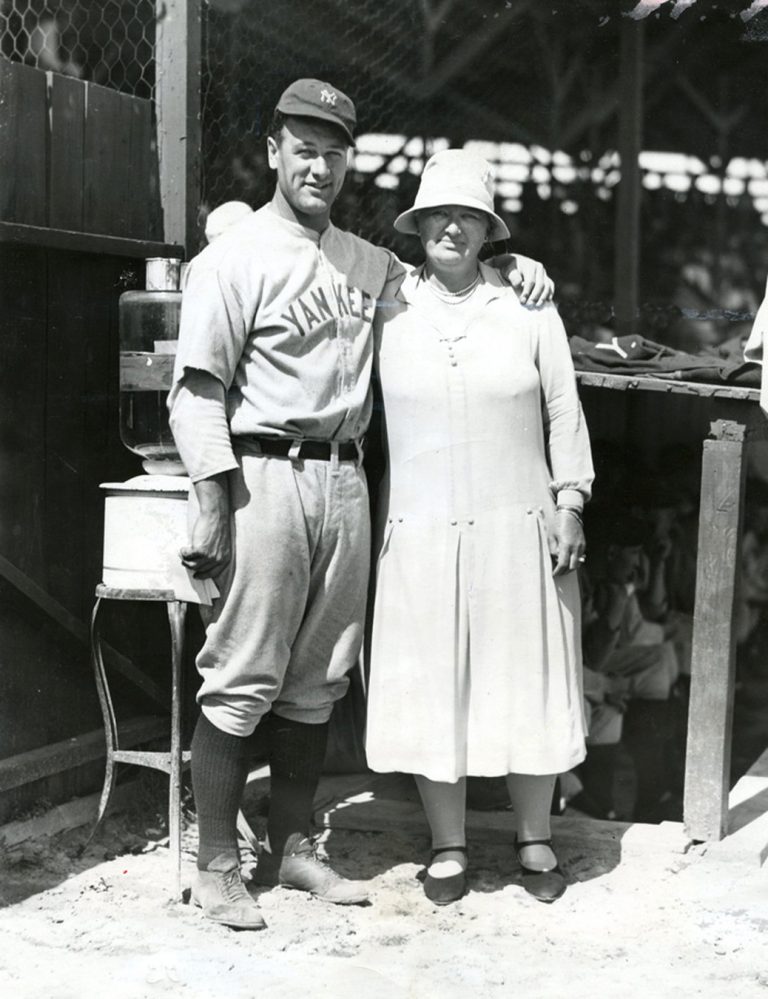
Christina Gehrig, the Iron Horse’s Iron-Fisted Mom
By Joe Guzzardi
Lou Gehrig had two women in his life, his mother Christina and his wife Eleanor. Had the two been able to get along, the personal life of the legendary New York Yankees ballplayer and Hall of Famer would have been less stressful.
During Gehrig’s youth, Christina, a first-generation German immigrant, was the family’s backbone. Father Heinrich was mostly unemployed, drank and was frequently ill. Lou was the only one of the Gehrig babies to reach adulthood. Three others died in their infancy. Understandably, Christina became overprotective of Lou and urged him to abandon baseball, which he picked up as a teen playing in neighborhood games. She wanted him to focus on his school books.
When Gehrig enrolled in Manhattan’s Commerce High School, he starred in football and baseball. After Gehrig’s Commerce team beat Chicago’s Lane Tech High in Cubs Park, later Wrigley Field, the 10,000 in attendance knew they had seen a superstar in the making. In an account of Gehrig’s game-winning grand slam, the Chicago Tribune wrote that “his blow would have made any big leaguer proud….”
The Gehrig family was poor. While in high school, Christina worked as a Columbia University housekeeper at Sigma Nu Theta. Lou often went to the fraternity house to help his mother serve dinner and wash dishes. Gehrig also worked part-time jobs in butcher shops and grocery stores to help supplement the household income. A New York Giants scout arranged a 1921 Polo Grounds tryout for Gehrig, but no-nonsense manager John McGraw screamed at his coaches to get him off the field: “I’ve got enough lousy players without another one showing up.” For the balance of his managerial career, McGraw rued his hasty decision.
Lou and Christina
By 1925, Gehrig, age 22, was an established Yankees starter who began to challenge teammate Babe Ruth for homerun titles. The two, despite contrasting personalities – the shy, retiring Gehrig and the bombastic Ruth – became friends, fishing buddies and barnstorming partners, the “Bustin’ Babes vs. the Larrupin’ Lous. Christina, who by this time realized that professional baseball players could earn good paychecks, loved Ruth. The Bambino gifted Christina a puppy which she named Judge, a nickname for Ruth. The extra money Ruth generated was nice too. Lou made $2,000 more on the barnstorming tour than he did during the season.
Ironically, Ruth was at the center of a lifelong feud between Lou and his mother. Christina took a dim view of Lou’s girlfriends, seeing them as threats eager to win away her beloved son. When Chicago socialite Eleanor Grace Twitchell caught Lou’s eye, Christina strongly disapproved. In her autobiography, “My Luke and I,” Eleanor described herself as “young and rather innocent, but I smoked, played poker and drank bathtub gin….” But smoking and drinking weren’t the vices that most bothered Christina.
Mother Gehrig had heard through the grapevine that on a years-ago trip to Chicago, Ruth befriended Eleanor. Christina, and the entire baseball world, knew that Ruth didn’t maintain platonic relationships with women. When Lou and Eleanor married in 1933, friends had to persuade Christina to attend.
As Lou’s career flourished, the women cheered Lou on, albeit from separate vantage points. Christina and Eleanor watched with pride as Lou closed in on the most-consecutive-games-played record, then 2,130. But the rift between Christina and Eleanor never healed. Lou’s physical condition deteriorated – “like a great clock winding down,” wrote Eleanor. A butler, a housekeeper and his mother-in-law who moved into the couple’s two-story home in Riverdale nursed Gehrig, but not Christina.
After Lou passed, tension between the in-laws deepened. The parties disputed how Lou’s estate should have been divided. Heinrich and Christina believed that Eleanor was withholding monthly payments from a $20,000 life insurance policy payable to Lou’s parents. An out-of-court settlement was reached.
Christina and Heinrich faded from the news, and died quietly. Eleanor, however, remained prominent, at least publicly. Married to Lou for only eight years, widowed for 43, Eleanor approved the final draft of “The Pride of the Yankees,” donated Lou’s baseball treasures to the Hall of Fame, left $100,000 to Columbia Presbyterian Hospital, and another $100,000 to the Rip Van Winkle Fund for ALS research.
Privately, a lonely, friendless and childless Eleanor withdrew, drank excessively and, once, passed out, caught her bed on fire from smoking. At Eleanor’s 1984 funeral, only two attended, her attorney George Pollack and his wife. And so ended the sad Gehrig family saga; Lou gone too soon, and his family unhappily bickering all the way to their graves.
Joe Guzzardi is a Society for American Baseball Research and Internet Baseball Writers Association member. Contact him at guzzjoe@yahoo.com.
After long term Pennsylvania 108th District Rep Lynda Schlegal-Culver (12 years) won a special election on Jan. 31 for State Senate District 17, a special election was scheduled to replace her in the 108th.
It will be Tuesday, May 16.
Running are Trevor Finn (D), Michael Stender (R) and Elijah Skretching (L).
The district is In Montour and Northampton counties, including Rockefeller Township. It has been a Republican seat for about 60 years.
For possibly the first time ever in a Pennsylvania State House race, both major Party Candidates are firefighters.
Trevor Finn worked at Finn’s News Agency, the family business. He has been Commissioner of Montour County since 2004. He has been operations chief and facilities commissioner if the Montour County Emergency Management Agency. He has worked as an EMT and volunteer firefighter.
He lives in Danville with his wife, Betsy, a kindergarten teacher. They have two children who became teachers.
Michael Stender is a firefighter and a former emergency room technician.
Stender is a lifelong resident of Sunbury and he and his wife have three daughters. He is a Bloomsburg graduate and has done various volunteer work.
The Libertarian Candidate Elijah Scretching spent five years in the Marines. He lives in Northumberland Borough with his wife and daughter.
In a candidate’s debate, he said “I want the people to have the power, not the government”. He is in favor of having armed guards in the schools because “We have to stop being reactive and start being proactive.”