Answer to yesterday’s William Lawrence Sr Cryptowit quote puzzle: The time is near at hand which must determine whether Americans are to be free men or slaves.
George Washington
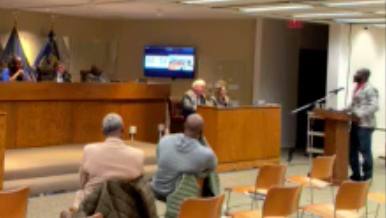
Delco Prison Conditions Nearing Crisis Level, Council Told — Frank Kwaning, president of the Delaware County (Pa.) Prison Employees Independent Union, gave a dire warning to County Council, Dec. 13. (2:14.30).
Membership asked him to inform the council that “things going on in the facility” are bad, he said.
“We don’t know what is being said out here and we don’t know what the council has been told,” he said. “But the reality on the ground is not as conducive as is portrayed,. You will be reading it in the news, you will be hearing it from somewhere.”
He begged the council to go to the prison to see things for themselves. He begged them to talk to the personnel.
“The morale is at the lowest level,” he said.
He thanked the council for the $3 raise they got in the latest contract but said membership is still being treated like garbage.
“On behalf of the members, we invite the council to step into the jail and conduct an investigation as to what is going on.”
He said Council better address things before things gets out of hand.
Delco Prison Conditions Nearing Crisis Level, Council Told
William Martin Retires As Delco Solicitor — William Martin, yesterday, Dec. 13, announced his retirement (1:49) as Delaware County, Pa. solicitor effective at the end of the month.
He took some cheap shots at election integrity activist in his farewell speech (1:50.50)
“One thing of which I have been proudest . . . is protecting the right to vote in Delaware County,” he said.
And passing a law weakening traditional minority influence on the Election Board? You are strongly fighting to keep it. How is that protecting the right to vote?
Solicitor William Martin, Dec. 13
Why aren’t you allowing specific precinct recounts as allowed by simple reading of the law? Why aren’t you allowing poll watchers to challenged ballots at the Wharf absentee ballot counting center as they would at any precinct?
By the way, the cite from the German philosopher Karl Jaspers was top-flight gaslighting . You think think skeptics and questioners are unreasonable?
Again, why did you fight right-to-know requests AFTER the state Office of Open Records ruled against you?
And are you going to collect a pension? How long did you work for Delco?
Tax Penn Endowment Profit Fairly — The endowments at Penn, Harvard and MIT have more than $95 billion in assets yet only pay a 1.4 percent tax rate on net investment income, says Sen. J.D. Vance (R-Oh)
Vance introduced a bill, today, Dec. 14, that would tax these endowments at 35 percent income.
It’s about time.
By the way, the presidents at these corrupt, bigoted, anti-semitic universities have salaries in the high six to even seven-figure range.
Vivek Cut Off While Explaing J6 Concerns — Vivek Ramaswamy was asked by moderator Abby Phillip at the CNN town hall in Des Moines, Iowa, yesterday, Dec. 13, concerning his claim that Jan. 6 was an inside job.
He began a long, detailed, fact-based answer and just as he was about to make the definitive points, Abby cut him off.
That’s not journalism. Heavens to Betsy, why would CNN do that?
Seriously, you know the answeer.
CNN is Nazi-like propaganda in service to the enemies of freedom.
Answer to yesterday’s William Lawrence Sr Cryptowit quote puzzle: There’s no system foolproof enough to defeat a sufficiently great fool.
Edward Teller
Chesco Courts Inspire Dirty Secrets Of Divorce — We met attorney Renee Mazer at Wednesday’s hearing concerning election transparency in Delaware County and learned she is an author, a bit of a comedienne, and a crusader for reform in Pennsylvania’s family courts.
Her book The Dirty Secrets of Divorce or What Your Lawyer Won’t Tell You is a warning about the dangers and costs of divorce along with the apparent corruption that makes divorce far more painful and expensive than it has to be.
This apparent corruption includes the alleged theft of property and untenable and unconcionable loss of access to children.
It’s based on what she experienced in Chester County family courts during her divorce, and what she saw in countless other cases from around country.
Besides the book, Renee has created a whole new method for divorce called The Mazer Method, which is almost court free.
“We act as coaches,” she said. “We don’t act as lawyers.”
Basically, the parties file their own papers and little or no time is before a judge.
It is much more affordable and healthier, she says. She says her clients are quite pleased with the service, and their kids are doing great.
And she’s also considering going into comedy.
And she says that her experiences with Pennsylvania’s family court system have left her with strong opinions regarding divorce.
“Hypothetically, I can unequivocally say . . . I would choose a psychopathic, child torturing spouse I haven’t had sex with in years over child torturing psychopathic lawyers and judges who screw me on a daily basis,” she said.
Like a eunuch lusting to violate a girl William Lawrence Sr Cryptowit 12-13-23
Aolyl’z uv zfzalt mvvswyvvm luvbno av klmlha h zbmmpjpluasf nylha mvvs.
Lkdhyk Alssly
Answer to yesterday’s William Lawrence Sr Cryptowit quote puzzle: Like a eunuch lusting to violate a girl is the person who does right under compulsion.
Sirach 20:4
The endless college football bowl season is upon us. Beginning on Dec. 16 with the Mrytle Beach Bowl, and mercifully ending on Jan. 8 with the CFP National Championship game, 43 games will be played. But no football game ever played, or ever to be played, will exceed the drama surrounding the Mosquito Bowl, played on insect-infested Guadalcanal in 1944. The 4th and 29th U.S. Marine Corp regiments faced off before their next stop, Okinawa.
The Mosquito Bowl evolved from a bold claim that Brown University and eventual New York Giants superstar John McLaughry made to his father. McLaughry claimed that the 4th Regiment could go toe-to-toe with the NFL champion Chicago Bears. McLaughry backed off a bit but still maintained that the 4th and the 29th combined could beat any team, anywhere.
To lift the Marines’ spirits, the brass okayed a football game between the 4th and the 29th for Christmas Eve 1944. The regiments had long debated which would prevail if they ever met on the football field. By kickoff time, there was a regulation-size field with goalposts, programs with roster information, a marching band and more than a thousand spectators. The excitement was so high that the Marine Corps radio network broadcast the game, and wagering was at a feverish level.
With its six early round professional draft picks, the star-studded 29th took the field against the 4th which had players who had professional careers with the Detroit Lions, the Green Bay Packers and the Chicago Cardinals. Among the players were George Murphy, Notre Dame captain, a South Bend, Indiana clerk’s son; Tony Butkovich, a Purdue All-American, and one of seven sons of a central Illinois Croatian coal miner; McLaughry, a blocking back, and Brown’s heavyweight boxing champion; Robert Bauman, a Wisconsin Badgers tackle and punter. As a kid, after his father died, Bauman worked in onion fields near Chicago. David Schreiner was a Badgers All-American end whose German immigrant grandfather had established a prosperous family business.
The gridiron was dirt and gravel without a blade of grass. Two-handed tag, the official rule, was ignored. The Marines played in t-shirts and torn-off khakis. Although they came away battered and bruised, no one complained. The game, which ended in a 0-0- tie, distracted from training for the Okinawa invasion which they correctly described as being “bound for hell.”
Of the 65 Mosquito Bowl players, 56 played in colleges, including Notre Dame, California, Purdue and Wisconsin, and five were team captains. Fifteen died during the fierce Okinawa fighting, the Pacific War’s bloodiest battle. After 82 days of brutal combat, more than 240,000 people had been killed, a 3,000 daily average. The American loss rate was 35 percent of the force, totaling 49,151 casualties. Of those, 12,520 were killed or missing, and 36,631 were wounded in action.
Wisconsin teammates Bauman and Schreiner were among those killed in action. Heavy Japanese fire blindsided Bauman’s platoon, and a bullet to his head shattered his skull. Bauman, age 24, became the 12th Mosquito Bowl player killed. On the day before Okinawa was declared secure, Schreiner was shot in the upper chest. Schreiner had weathered 81 of the 82 days that the battle lasted before dying in the hospital on the 82nd day. Schreiner was the 15th and final Mosquito Bowl fatality.
Ironically, Schreiner could have stayed behind. He rejected a medical school deferment and instead enlisted. Schreiner wrote in a letter to his parents: “I’m not sitting here snug as a bug, playing football while others are giving their lives for their country…If everyone tried to stay out of it, what a fine country we’d have!”
After learning of their sons’ deaths, the mothers of Schneider and Bauman corresponded. Bertha Bauman to Anne Schreiner: “Our two darling boys were real pals and went through everything together and seems they could not be separated and for that reason, God took them both.” Anne replied: “Are your days and nights getting any better, Mrs. Bauman? I find mine are getting harder and harder.”
In 1947, Anne wrote to Bertha again after Bauman and Schreiner’s fiancées had married. Although Anne was happy that Odette, a WAVE and her faithful friend throughout, now would have the chance “to build another future for the one that was taken away,” she was saddened because “she [Odette] had been David’s, and oh, oh, doesn’t it hurt?”
During the same year, the University of Wisconsin renamed two dormitories for Bob Bauman and Dave Schreiner. At the dedication, with family and friends present, tears flowed. Two years later, the U.S. military closed its Okinawa cemeteries, and Schreiner’s remains were returned home and buried in the family plot. Anne lived until age 105, and to her the Badgers were always “her boys.” Before she moved into a nursing home at age 99, she kept David’s room exactly as it was the day he left for the Marines.
The lucky, living 50 Mosquito Bowl competitors returned home, but most were never the same. After receiving a telegram her son John sent from San Francisco that read “short time, then home soon, love,” his mother picked him up at Grand Central Station. Gone was the Brown University swagger, replaced by, in his mother’s words, a reclusive, jittery man who was an “empty shell that held empty eyes.”
The three and a half hours long Mosquito Bowl that the 65 Marines reveled in may have been the last and longest sustained joyous moments the brave young soldiers ever experienced in their war-shortened lives.
Joe Guzzardi is a Society for American Baseball Research and Internet Baseball Writers Association member. Contact him at guzzjoe@yahoo.com.
Marines Play Mosquito Bowl on Christmas Eve 1944Marines Play Mosquito Bowl on Christmas Eve 1944
 Answer to yesterday’s William Lawrence Sr Cryptowit quote puzzle: The time is near at hand which must determine whether Americans are to be free men or slaves.